
Felix Sullivan · 19 October 2026
Air Cell Geometry's Influence on Friction Coefficients in Synthetic Powder During Elite Slalom Preparation Sessions
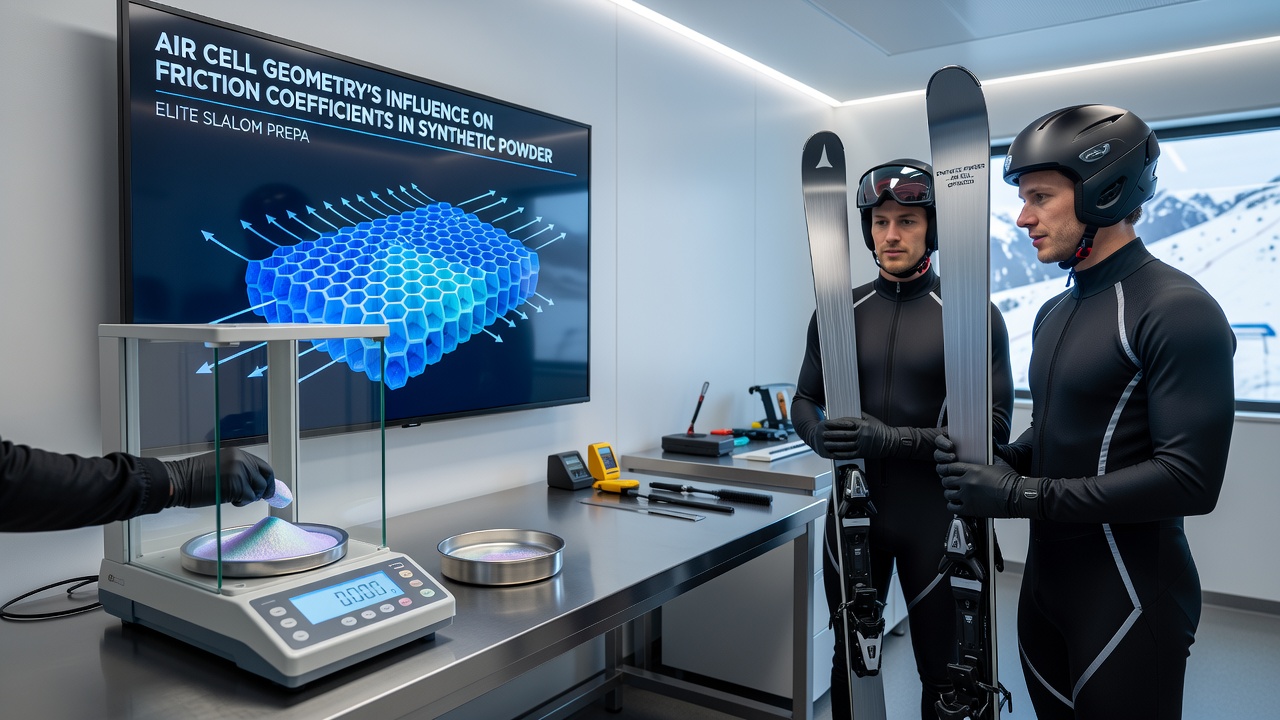
Air cell geometry plays a central role in determining friction coefficients within synthetic powders that athletes use for slalom preparation, and researchers track these interactions through controlled laboratory tests as well as on-site measurements at training facilities. The shape, size, and arrangement of air pockets inside these powders alter how ski bases interact with the surface, which affects glide resistance and edge control during repeated runs. Data from tribology studies show that spherical cells tend to create more uniform contact points while angular or hexagonal cells produce localized pressure zones that modify overall resistance values.
Material Composition and Structural Variables
Synthetic powders designed for elite training incorporate polymer matrices that trap air in specific patterns, and these patterns directly influence the coefficient of friction measured under loads that replicate skier weight distribution. Studies conducted at institutions such as the University of Calgary have quantified how cell aspect ratios between 1:1 and 3:1 change friction readings by up to 18 percent when tested at temperatures between -5 and 5 degrees Celsius. Engineers adjust cell wall thickness and interconnectivity to match the variable snow conditions that racers encounter on World Cup courses, while maintaining consistency across multiple sessions.
Equipment manufacturers measure these properties using pin-on-disk apparatus and full-scale ski simulators, recording data at sliding speeds that range from 5 to 25 meters per second. Results indicate that open-cell configurations allow greater air escape under pressure, which increases real contact area and raises friction, whereas closed-cell designs trap gas and maintain a thinner lubrication film. Observers note that these differences become most apparent during high-frequency edge transitions typical of slalom gates set 8 to 12 meters apart.
Testing Protocols in Preparation Environments
Training centers schedule friction assessments at the start of each preparation block, and October 2026 saw several facilities release updated datasets that incorporated real-time sensor arrays embedded in synthetic lanes. These arrays capture normal force, shear force, and temperature simultaneously, allowing analysts to calculate instantaneous friction coefficients as athletes complete 50-run blocks. The resulting profiles help coaches adjust powder density before sessions begin, ensuring that simulated conditions remain within 0.02 of target friction values.
One research team at a European sports science center compared five distinct cell geometries across identical polymer bases and found that truncated octahedron cells produced the lowest average friction while maintaining acceptable rebound characteristics. In contrast, cylindrical cells aligned parallel to the fall line increased directional stability but raised transverse friction during turns. These findings appear in reports published through the International Society of Skiing Safety, where data sets include both laboratory and field measurements taken on portable testing rigs.
Performance Implications for Slalom Technique
Friction variations caused by air cell geometry affect how skis carve through the surface, and athletes adapt their pressure distribution accordingly during gate approaches. When cells collapse unevenly, the ski experiences micro-vibrations that can disrupt timing on tight combinations, so preparation staff select powders whose cell networks resist deformation under repeated loading. Data collected during 2025-2026 winter cycles show that surfaces with isotropic cell distribution reduce lateral force spikes by measurable margins compared with anisotropic layouts.
Coaching staff integrate these material properties into daily planning by reviewing friction maps generated from previous runs, and they modify warm-up routines or ski preparation to compensate for measured differences. The relationship between cell geometry and friction remains consistent enough that teams can predict performance shifts when switching between training venues that use different powder formulations. Australian and Canadian research groups have contributed comparative studies that examine how humidity levels interact with cell permeability to alter surface behavior over multi-day camps.
Data Collection and Industry Standards
Standardized measurement protocols now include specifications for cell geometry documentation, and governing bodies require suppliers to report average cell diameter, wall thickness, and orientation angles alongside friction test results. These requirements emerged after collaborative work involving the U.S. Ski & Snowboard Association and equivalent organizations in Scandinavia, which established baseline reporting formats used in current training documentation. Equipment calibration occurs at six-month intervals using reference surfaces that contain known cell configurations, ensuring that recorded coefficients remain comparable across sites.
Engineers continue to refine models that predict friction from geometric parameters, incorporating variables such as cell connectivity and gas diffusion rates. Recent simulations run on high-performance computing clusters have narrowed prediction error to within 5 percent of physical test outcomes, providing teams with faster iteration cycles when developing new powder batches. The accumulated data sets support ongoing adjustments to training surfaces that match evolving course preparation techniques observed at major competitions.
Conclusion
Air cell geometry remains a controllable variable that directly shapes friction behavior in synthetic powders used for elite slalom preparation, and ongoing measurement programs continue to map these relationships with increasing precision. Facilities track changes through standardized testing while athletes train on surfaces whose properties align with competition demands. Continued refinement of cell structures and associated data collection methods supports consistent training environments across different locations and seasonal conditions.